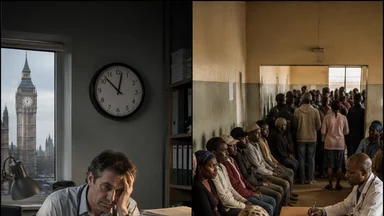
London NHS Psychiatrist Caseload Reaches 600 While Durban Clinic Sees One Doctor per 50,000
In a London NHS trust, a consultant psychiatrist might carry a caseload of 600 patients. That number is not an outlier; it appears in workforce surveys and internal trust documents as a routine reality. Six hundred people, each with a diagnosis that requires ongoing medication management, periodic review, and at least a modicum of therapeutic contact. Meanwhile, in Durban, South Africa, a single psychiatrist at a public sector clinic may be responsible for a catchment population of roughly 50,000. The ratio is so skewed that the clinician becomes a triage officer, not a therapist. The two settings are separated by geography, income, and history, yet they share a common pathology: the health system breaks the very people it depends on to heal.
Two Systems, Same Strain: How Caseload Breaks the Clinician
The London psychiatrist with 600 patients does not see all of them regularly. In practice, a caseload that size means scheduled follow-ups every 12 to 16 weeks for stable patients, and urgent slots reserved for those in crisis. A typical outpatient clinic might list 15 to 20 patients per session, each allocated 20 minutes. The clinician spends those minutes scanning notes, checking side effects, adjusting doses, and moving on. There is little time for talk therapy or exploring the social determinants that drive relapse.
In Durban, the public sector psychiatrist sees a similar volume per clinic day—sometimes 80 patients in a single session. The difference is that the catchment area is larger and the support staff thinner. A community health centre might have one psychiatric nurse and a social worker for every 50,000 people, but the doctor alone carries the prescribing authority. The consultation often boils down to a five-minute check: “Are you taking your medication? Any side effects? See you in three months.”
The burnout mechanics are identical. Both clinicians operate in a state of chronic time pressure. Both ration their attention. Both experience moral distress when they know a patient needs more but cannot give it. A 2023 survey of NHS psychiatrists found that over 60% reported emotional exhaustion, and a quarter said they planned to leave the profession within five years. South African data from the same period show that psychiatrist burnout rates exceed 50% in public sector facilities, with emigration a constant drain.
The ratio hides the identical process: diagnosis becomes triage, not therapy. In both systems, the clinician’s primary function shifts from healing to gatekeeping—deciding who is sick enough to justify a 20-minute slot, who can wait, who must be referred to an already overloaded crisis team. The patient experience becomes transactional. The clinician’s sense of purpose erodes.
The Training Pipeline Leak at Both Ends
The United Kingdom trains roughly 500 psychiatrists each year, but the number of specialty training posts has not kept pace with demand. As of late 2024, around 10% of consultant psychiatrist posts in England were vacant, and some trusts reported vacancy rates above 20% in child and adolescent mental health services. The training pipeline is clogged at the entry point: medical graduates often choose other specialties because psychiatry is perceived as under-resourced and high-burden.
South Africa faces a different but equally damaging leak. The country produces about 40 to 50 psychiatrists annually, but an estimated 30% to 40% of medical graduates emigrate within five years of completing their training. The United Kingdom, Australia, and Canada are common destinations, where salaries are higher and working conditions less punishing. A psychiatrist in South Africa’s public sector earns roughly one-tenth of what a colleague in the NHS takes home, adjusted for purchasing power.
Specialist training slots in both countries are capped by budget, not by need. In the UK, Health Education England controls the number of training posts, and expansion requires a multi-year business case. In South Africa, the number of registrar posts in psychiatry is limited by the availability of senior consultants to provide supervision. That supervision ratio is itself a problem: a single senior consultant may oversee four or five registrars, diluting the quality of training and increasing the risk of burnout among the supervisors themselves.
New consultants in both systems often burn out within five years. A UK study published in the British Journal of Psychiatry in 2025 found that nearly one-third of early-career consultants reported high levels of depersonalisation and emotional exhaustion. In South Africa, a similar study from the University of Cape Town showed that burnout rates among psychiatrists in their first five years of practice exceeded 40%. The system trains clinicians, then grinds them down.
What the Caseload Number Actually Does to Care
When a psychiatrist carries 600 patients, the average consultation time shrinks. In the NHS, a standard follow-up appointment is 20 minutes. That might sound adequate, but consider what a 20-minute slot must cover: review of symptoms, medication side effects, adherence check, blood test results, and a brief assessment of risk. There is no room for psychotherapy or for exploring the patient’s social context—housing instability, debt, isolation. Those factors often drive relapse, but they are invisible in a 20-minute chart review.
In Durban, the consultation is even shorter. A psychiatrist seeing 80 patients in a clinic day might allocate 10 minutes per patient, sometimes less. The focus narrows to medication management: “Are you still taking your tablets? Any problems?” If the patient is stable, the prescription is renewed. If they are unwell, the dose is adjusted or a depot injection is given. Psychotherapy is absent. The doctor’s role becomes that of a medication dispenser with a medical degree.
Follow-up intervals stretch to three months or more in both systems. For a patient with schizophrenia, three months between appointments is a long time. Early warning signs of relapse—sleep disturbance, social withdrawal, suspiciousness—may go unnoticed until a full-blown psychotic episode lands the patient in an emergency department. The same dynamic plays out for depression and bipolar disorder: long intervals mean that deterioration is caught late, if at all.
Relapse prevention becomes crisis response. In the NHS, crisis resolution and home treatment teams are designed to manage acute episodes, but they are also overstretched. In South Africa, the gap is even wider: many rural areas have no crisis service at all, and the only option is a psychiatric ward in a regional hospital, often hours away. The caseload number is not an abstraction; it dictates whether a patient gets preventive care or waits until they break down.
Why Money Alone Cannot Fix the Workforce Gap
The UK government has announced pay increases for NHS psychiatrists in recent years, including a 6% rise in 2024/25. Yet retention has not improved. A Royal College of Psychiatrists survey from early 2025 found that only a third of psychiatrists felt their workload was manageable, and pay was not the top reason for leaving—workload and lack of time for patients were cited more often. Money helps, but it does not reduce the caseload.
South Africa’s rural allowance, a financial incentive for doctors working in underserved areas, has been in place for over a decade. Studies show it has a modest effect on attracting new graduates but does little to retain them beyond the two-year commitment period. The allowance, roughly 10% to 15% of base salary, is not enough to compensate for the lack of professional support, poor infrastructure, and isolation that many rural psychiatrists experience.
Task-shifting—training nurses, community health workers, and general practitioners to deliver mental health care—has been promoted as a solution in both settings. In the UK, the NHS Long Term Plan expanded the role of psychological therapists and mental health nurses. In South Africa, the National Mental Health Policy Framework encourages integration of mental health into primary care. These efforts work partly: they extend the reach of the system and free up psychiatrists for complex cases. However, they also place a heavy supervision burden on the few senior clinicians available. For example, in KwaZulu-Natal, a single consultant psychiatrist may supervise up to 10 psychiatric nurses in primary care clinics, leaving little time for their own patient load. In the UK, a consultant may oversee a team of 15 therapists and nurses, but the supervision sessions are often squeezed into already packed clinic days.
Burnout feeds emigration, and emigration feeds burnout. A psychiatrist who stays in a high-caseload system watches colleagues leave and feels the pressure increase. The ones who remain become more cynical, more exhausted, and more likely to leave themselves. It is a feedback loop that money alone cannot break. What might break it is a structural reduction in caseload, which requires either more clinicians or a different model of care.
Counter-Arguments: Can Task-Shifting and Digital Tools Help?
Not all evidence points to doom. Task-shifting, when implemented with adequate training and supervision, has shown promise in both settings. In the UK, the Improving Access to Psychological Therapies (IAPT) programme has trained over 10,000 psychological therapists to deliver evidence-based therapy for depression and anxiety, reducing the demand for psychiatrist-led care. A 2024 evaluation found that IAPT patients had recovery rates comparable to those seen in specialist mental health services, and the programme reduced the average waiting time for therapy from 18 weeks to 6 weeks in some areas. The catch is that IAPT focuses on mild to moderate conditions; patients with severe or complex needs still require psychiatrist input.
In South Africa, the Western Cape Department of Health piloted a collaborative care model in 2022, where psychiatric nurses and general practitioners manage common mental disorders under remote supervision by psychiatrists. A study published in the South African Medical Journal in 2024 showed that patients in the pilot had better adherence to medication and fewer hospitalizations compared to those in standard care. However, scaling the model nationally would require an estimated 500 additional psychiatric nurses and a doubling of the current psychiatrist workforce for supervision—a costly and time-consuming proposition.
Digital tools offer another avenue. Telepsychiatry has expanded rapidly since the COVID-19 pandemic, with the NHS reporting that over 30% of psychiatric consultations were conducted remotely in 2024. Studies show that video consultations are acceptable to patients and can reduce travel time, especially for those in rural areas. In South Africa, the nonprofit organization Strong Minds has deployed a mobile app for depression screening in KwaZulu-Natal, linking patients to nurse-led follow-up. A 2023 evaluation found that the app increased treatment initiation by 40% in pilot clinics. Yet digital tools are not a panacea. They require reliable internet and electricity, which are not universal in rural South Africa. In the UK, digital exclusion affects older adults and those with severe mental illness, who may lack access to smartphones or struggle with technology. A report by the Royal College of Psychiatrists in 2024 warned that telepsychiatry could widen inequalities if not paired with in-person options.
These counter-arguments do not invalidate the crisis, but they show that partial solutions exist. The challenge is scaling them without overburdening the clinicians who remain.
The Ripple Effect on Patients and Populations
Long waits for psychiatric care push mild cases toward severity. In the NHS, the median waiting time for a first outpatient appointment with a psychiatrist is roughly 12 weeks, but in some trusts it exceeds six months. During that wait, a patient with moderate depression may deteriorate, lose their job, or attempt suicide. A similar dynamic plays out in South Africa, where waiting lists for psychiatric clinics in KwaZulu-Natal can stretch to four months.
Emergency department visits spike for preventable crises. A 2024 analysis of NHS data found that mental health-related A&E attendances increased by 18% over three years, with the largest rise among patients with chronic conditions like schizophrenia and bipolar disorder. In South Africa, a study at a Durban hospital showed that over half of psychiatric admissions came through the emergency department, and most were for conditions that could have been managed outpatient if follow-up had been timely.
Chronic conditions like depression go undertreated. The WHO estimates that in low- and middle-income countries, fewer than one in five people with depression receive adequate treatment. In South Africa, the treatment gap for depression is around 75%. In the UK, it is lower—around 30%—but still substantial. The gap is not just about medication; it is about continuity of care, therapeutic alliance, and the kind of sustained attention that a high caseload makes impossible.
Suicide rates correlate with psychiatrist shortages at the population level. A 2023 study in The Lancet Psychiatry found that regions in England with the lowest psychiatrist-to-population ratios had significantly higher suicide rates. The same pattern has been observed in South African provinces: the Western Cape, which has a relatively higher psychiatrist density, has lower suicide rates than the Eastern Cape, where the ratio is worse. The association is not simple causation, but the pattern is consistent enough to warrant concern.
What a Sustainable Workforce Would Actually Look Like
Half the current caseload per clinician is the minimum target that workforce planners in both countries have floated. For the NHS, the Royal College of Psychiatrists' 2023 workforce report recommends reducing a consultant’s caseload from 600 to around 300, based on a study in the British Journal of Psychiatry that found clinicians with caseloads above 300 had significantly higher burnout scores (measured by the Maslach Burnout Inventory) and lower patient satisfaction ratings. For South Africa, the South African Society of Psychiatrists has proposed lowering the catchment ratio from 1:50,000 to 1:25,000, citing a 2022 study from the University of KwaZulu-Natal that showed improved outcomes in clinics with a ratio below 1:30,000.
Integrated primary care can reduce the referral burden. When general practitioners are trained and supported to manage common mental health conditions—depression, anxiety, alcohol use disorders—fewer patients need to see a psychiatrist. The UK has made progress with the IAPT programme, but integration remains patchy. South Africa has piloted collaborative care models in the Western Cape, with promising results, but scaling them nationally requires investment in primary care infrastructure, including training of nurses and the installation of electronic health records to facilitate remote supervision.
Digital tools can extend reach without replacing human touch. Telepsychiatry has grown rapidly since the pandemic, and studies show that video consultations are acceptable to patients and can reduce travel time. But digital tools are not a panacea. They work best when they supplement—not substitute for—in-person care, and they require reliable internet and electricity, which are not universal in rural South Africa. A similar challenge with technology adoption has been documented in other low-resource settings, such as rural Kenya, where mobile health initiatives have struggled with network coverage and device maintenance.
Training must expand without degrading quality. Increasing the number of medical school places and psychiatry training posts is necessary, but it must be paired with adequate supervision and a supportive work environment. Otherwise, new graduates will simply burn out faster. Retention requires career progression—opportunities for research, teaching, and leadership—not just pay. A psychiatrist who sees a future in the system is more likely to stay than one who feels stuck in a perpetual clinic treadmill.
There is no single fix. The workforce gap is a product of underinvestment, poor planning, and the inherent difficulty of scaling a human-intensive profession—where each patient requires not just a prescription but a therapeutic relationship. Acknowledging that the problem is structural—not a matter of individual resilience—is a start. The clinician who carries 600 patients is not failing; the system that assigns them is.
This article is for informational purposes only and does not constitute professional medical advice. If you or someone you know is in crisis, contact a local mental health helpline or emergency service.