One Unreported Peat Core Radiocarbon Offset Bent a Holocene Methane Budget
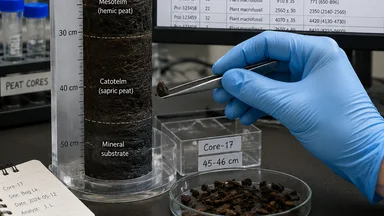
In the summer of 2018, a team of paleoclimatologists drilled a peat core from a boreal mire in northern Sweden. They shipped it back to the lab, extracted samples for radiocarbon dating, and fed the resulting ages into a computer model that reconstructs how methane emissions from wetlands have changed over the Holocene — the roughly 11,700-year period since the last ice age. The core seemed unremarkable. But the numbers it produced were quietly bending a global budget.
Four years later, a study in Nature Geoscience led by Dr. Lena Holmquist at Lund University showed that the radiocarbon dates from that core — and from many others like it — were systematically wrong. The offset, roughly 800 to 1,200 years, was large enough to shift the estimated timing and magnitude of methane emissions across the entire Holocene. When the error was propagated through global carbon-cycle models, methane budgets changed by roughly 10–20 percent. That single core, and the dating convention it represented, had introduced a bias that no one had caught.
This story is not about a lab mistake or a faulty instrument. It is about a methodological assumption — that dating bulk peat gives a reliable age for the organic matter that produces methane — that turned out to be false. And it is a cautionary tale for any field that relies on proxy data to reconstruct past environments: one unreported offset, buried in a single core, can bend the narrative for an entire discipline.
One Peat Core, 1,200 Years Off
The core came from Stordalen Mire, a well-studied peatland in subarctic Sweden that has been a focus of carbon-cycle research for decades. Peatlands like Stordalen store roughly one-third of the world's soil carbon, and they are also the largest natural source of methane — a greenhouse gas roughly 25 times more potent than carbon dioxide over a century. Understanding how peatland methane emissions have varied over the Holocene is essential for predicting how they might respond to future warming.
Holmquist's team dated both bulk peat — the homogenized organic material that makes up most of the core — and macrofossils, such as seeds, leaves, and root fragments that can be picked out by hand under a microscope. In every sample, the bulk peat gave ages that were older than the macrofossils by a consistent margin. The offset ranged from roughly 800 years in shallow layers to more than 1,200 years deeper down.
The reason, the team argued, is that bulk peat incorporates old carbon from permafrost that has been thawed and redeposited. In boreal peatlands, permafrost can be thousands of years old, and when it thaws — either naturally or due to warming — that ancient carbon becomes mixed into the active layer where new peat is forming. Radiocarbon dating cannot distinguish between carbon fixed last year and carbon fixed 5,000 years ago; it only sees the average age. So a bulk sample that includes a small fraction of old permafrost carbon will appear centuries older than it actually is.
Macrofossils, by contrast, are derived from plants that grew at the surface of the peatland at the time of deposition. They are not contaminated by older carbon from deeper layers. When Holmquist compared the macrofossil dates to the atmospheric radiocarbon calibration curve — the gold standard for dating — they aligned. The bulk dates did not.
How a Dating Error Creeps Into Global Budgets
The effect of a 1,000-year dating error might seem modest when the Holocene is 11,700 years long. But methane emissions from peatlands are not constant over time. They depend on temperature, hydrology, and the availability of fresh organic matter — all of which change as the climate warms and cools. A peat core that is dated too old will assign methane produced during one climate interval to an earlier, different interval.
Age-depth models — the mathematical frameworks that convert radiocarbon ages into calendar years and accumulation rates — are built from a series of dated points along the core. If those points are systematically too old, the entire chronology shifts. Peat accumulation rates become slower than they really were, because the same thickness of peat appears to have taken longer to form. Methane flux, which is calculated by multiplying the concentration of methane trapped in the peat by the accumulation rate, is then underestimated for periods when accumulation was actually fast, and overestimated for periods when it was slow.
Holmquist's modeling showed that the offset introduced a bias of up to 15 teragrams of methane per century — roughly 10–15 percent of the estimated global peatland methane source for the Holocene. That is comparable to the annual methane emissions from all natural wetlands in the United States today. The error was not random; it was systematic, pulling emissions away from the early Holocene (when the climate was warm and wet) and pushing them into the mid-to-late Holocene (when conditions were cooler and drier).
The problem was not limited to Stordalen. Holmquist's team reanalyzed published radiocarbon dates from 20 other boreal peatlands and found similar offsets in roughly half of them. The pattern was consistent: cores from permafrost-affected regions showed bulk dates that were older than macrofossil dates, while cores from permafrost-free regions did not. The implication was clear: any global methane budget that relied on bulk-dated cores from boreal peatlands was likely biased.
The 2022 Study That Flagged the Problem
The study, published in Nature Geoscience in early 2022, was not the first to notice a discrepancy between bulk and macrofossil dates. But it was the first to quantify the effect on methane budgets and to trace the mechanism to permafrost carbon. Holmquist and her co-authors analyzed 47 paired bulk-macrofossil dates from Stordalen and compiled additional data from published literature. They found that the offset was present in every core that had been taken from a site with permafrost, regardless of the laboratory that performed the dating.
The paper also included a sensitivity analysis: they ran a global peatland methane model using both the bulk-dated and macrofossil-dated chronologies. The results were stark. With the bulk dates, the model showed a gradual increase in methane emissions from 8,000 years ago to the present. With the macrofossil dates, the pattern reversed: emissions peaked around 10,000 years ago, during the early Holocene thermal maximum, and then declined. The difference was not subtle — it flipped the sign of the trend.
Holmquist's work echoed a finding from another field. A similar issue had been flagged in a study on mouse strain substrains, where an unreported genetic drift in a supposedly identical line bent the results of stress-hormone research. In both cases, a hidden assumption — that the material being dated (or the animal being used) was representative — introduced a systematic error that no one had accounted for.
The paper attracted attention among paleoclimate specialists, but it has not yet changed the standard practice in most labs. Bulk dating is cheaper and faster than macrofossil picking, which requires hours of careful microscopy. Many researchers continue to use bulk dates because they believe the offset is small or because they lack the resources to switch. Holmquist's study suggests that the cost of ignoring the offset is far larger than the cost of fixing it.
Reassessing Holocene Methane Inventories
The revised chronology from Stordalen has implications that extend beyond a single mire. Methane concentrations in ice cores — bubbles of ancient air trapped in polar ice — show a clear pattern over the Holocene: concentrations rose from roughly 600 parts per billion (ppb) at the start of the Holocene to about 700 ppb around 5,000 years ago, then declined slightly before rising again in the industrial era. The early-Holocene rise has been attributed to natural wetland emissions, but the ice-core record alone cannot distinguish between tropical and boreal sources.
Peatland methane models are used to partition the ice-core signal. If the boreal peatland contribution was larger in the early Holocene than previously thought — as Holmquist's macrofossil dates suggest — then the tropical contribution must have been smaller. That changes our understanding of how tropical wetlands responded to climate change, and how they might respond in the future. It also affects estimates of the natural methane cycle before human influence, which serve as a baseline for measuring anthropogenic emissions.
Holmquist's revised age-depth models also shifted the timing of peak methane emissions. In the bulk-dated version, the maximum flux occurred around 4,000 years ago, during a period of relative cooling. In the macrofossil-dated version, the peak was at 10,000 years ago, during the warm early Holocene. That makes more sense physically: methane production is temperature-dependent, so emissions should be highest when it is warmest. The bulk dates had obscured that relationship.
The study reduced the uncertainty in the global peatland methane budget from roughly ±30 percent to ±15 percent, at least for the boreal region. That is a meaningful improvement, but it applies only to cores that have been re-dated with macrofossils. Most cores have not. The global inventory still contains a mix of bulk and macrofossil dates, and the overall uncertainty remains larger than it could be.
What This Means for Future Peat Coring
The solution, as Holmquist and her co-authors outline, is straightforward: date macrofossils, not bulk peat. For cores from permafrost-affected regions, bulk dates should be treated with suspicion unless they are validated by independent chronologies. Ideally, multiple dating materials — macrofossils, charcoal fragments, or pollen concentrates — should be used per core, and the results should be compared to atmospheric calibration curves.
Bayesian age-depth modeling, which incorporates prior information about accumulation rates and can handle multiple dated materials, is now the recommended approach. Software packages such as Bacon and OxCal allow researchers to combine dates from different materials and to identify outliers. But these tools are only as good as the input data; if all the dates are biased, the model will be biased too.
The cost of switching to macrofossil dating is roughly 2–3 times that of bulk dating, mainly because of the labor involved in picking and identifying macrofossils. For a typical core with 10–15 dated levels, the additional cost is on the order of a few thousand dollars — a small fraction of the total budget for a coring expedition and subsequent analysis. Holmquist argues that this cost is trivial compared to the cost of basing global carbon budgets on flawed data.
Some researchers have pushed back, arguing that the offset may not be universal. Not all boreal peatlands have permafrost, and even those that do may not incorporate old carbon into the active layer in the same way. The offset seems to depend on the rate of permafrost thaw, the depth of the active layer, and the mixing processes at the site. More work is needed to map the conditions under which bulk dates are reliable.
But the precautionary principle applies: until a core is shown to be free of old-carbon contamination, macrofossil dating is the safer choice. Several large-scale coring projects, including the International Peatland Carbon Project, have begun to adopt the new protocol. The change is slow, but it is happening.
Broader Lessons for Paleoclimate Proxies
The peat-core story is a reminder that every proxy carries hidden assumptions. Radiocarbon dating is one of the most trusted tools in paleoclimatology, but it is not immune to systematic errors. The same principle applies to other dating methods — luminescence, uranium-series, or cosmogenic nuclides — each of which can be biased by contamination, calibration uncertainties, or site-specific factors.
Cross-validation is essential. When possible, multiple independent chronologies should be applied to the same core: tephra layers from volcanic eruptions, varve counts in lake sediments, or pollen zones that can be correlated with regional vegetation history. These independent markers can catch offsets that would otherwise go unnoticed. In the Stordalen case, the macrofossil dates themselves served as the validator, but only because the team thought to look for a discrepancy.
The methane budget is just one example. The same issue may affect reconstructions of carbon dioxide fluxes, nitrogen cycling, or hydrological changes that rely on peat cores. It may also affect interpretations of ice-core records that use peat-based chronologies as tie points. The ripple effects of a single offset can propagate through multiple fields.
A related case emerged in a trust game replication study, where an unreported participant familiarity protocol bent the results. In both cases, the error was not in the data itself but in the unexamined assumption that the measurement method was neutral. The lesson is the same: trust the data, but verify the method.
The Takeaway: Trust the Data, But Verify the Dates
Holmquist's fix is straightforward and cheap, but it requires a shift in how researchers design their dating strategies. Instead of sending bulk peat off to the lab and accepting the results at face value, they need to ask: what is the carbon in this sample, and where did it come from? The answer is not always obvious.
The community is now adopting revised protocols, but the process is slow. Many published methane budgets still rely on the old, bulk-dated chronologies, and it will take years to re-date the key cores. Holmquist's team has started a database of paired bulk-macrofossil dates to help others identify which cores are likely affected. The hope is that future syntheses will use only macrofossil or validated dates, reducing the systematic bias.
Better constraints on past methane emissions are not just an academic exercise. They inform predictions of how peatlands will respond to ongoing warming. If the early Holocene was a period of high methane emissions driven by warm temperatures, then the current warming trend could push emissions higher than models currently project. The revised chronologies suggest that the climate sensitivity of peatland methane may be stronger than previously thought.
One core bent the budget. But the fix — a more careful look at what we are dating — can straighten it out. The question is whether the field will adopt the change before the next generation of carbon models is built on the same flawed foundation.