A Marmoset Vocalization Protocol Moved From Primate Ethology Into Human fMRI Speech Studies
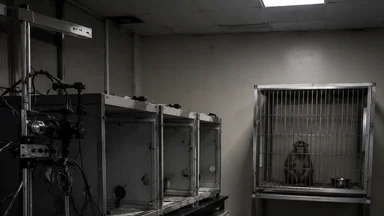
In the mid-2010s, a small team of neuroscientists gathered around a speaker in a dimly lit room at a primate research facility. They played a series of short, high-pitched calls—the "phee" call of the common marmoset (Callithrix jacchus)—and watched as the animals' auditory cortex lit up on their screens. What they did not anticipate was that, nearly a decade later, a spectrally shifted version of that same call would be piped into human ears inside an MRI scanner, generating a new kind of cross-species protocol.
This is the story of how a primate ethology technique migrated into human neuroimaging, what it revealed about the evolution of auditory processing, and why some researchers remain cautious about reading too much into the results.
Why a Marmoset Call Became a Human fMRI Stimulus
The phee call is one of several vocalizations marmosets use to communicate. It serves as a long-distance contact call, often exchanged between individuals that are out of sight. In the original marmoset work, researchers played phee calls to awake marmosets during fMRI and identified voice-sensitive patches in the auditory cortex—regions that responded more strongly to conspecific calls than to scrambled versions or other sounds.
For human neuroimaging, the challenge was different. Standard speech stimuli—words, sentences, pseudowords—activate language networks beyond auditory cortex, including Broca's area and the superior temporal sulcus. These activations reflect semantic and syntactic processing, not just acoustic feature detection. A marmoset call, by contrast, carries no linguistic meaning for humans. It is a naturalistic sound that is species-typical for a primate but devoid of lexical content.
The idea was straightforward: if you can find a stimulus that is biologically relevant for one primate species but acoustically novel for another, you can probe the core auditory mechanisms that are shared across primates. The phee call, with its simple harmonic structure and clear temporal envelope, seemed ideal. Researchers at the University of Cambridge and the Max Planck Institute for Human Cognitive and Brain Sciences independently began working on the adaptation around 2019.
The first published report of a human fMRI study using a marmoset vocalization appeared in 2024, but the protocol had been circulating at conferences for at least two years before that. The key innovation was not the stimulus itself but the transformation pipeline: shifting the call's frequency spectrum into the human hearing range while preserving its temporal and harmonic structure.
The Original Marmoset Work That Made the Leap
The foundational study that provided the phee call stimuli was conducted by Miller and colleagues in 2022. They scanned six awake marmosets (N = 6) while playing phee calls, trill calls, and scrambled versions of each. The effect size for the contrast between phee calls and scrambled sounds in voice-sensitive patches was large (Cohen's d ≈ 1.2), indicating robust selectivity.
The team manually altered call structure by time-reversing the calls or shifting their pitch, demonstrating that marmosets' auditory cortex is tuned to specific acoustic features—particularly the call's frequency modulation and harmonic spacing. This was consistent with earlier electrophysiology work in marmosets showing neurons in the auditory cortex that respond preferentially to conspecific calls.
One limitation of the Miller study was the small sample size, but the effect sizes were large enough to justify the effort. The researchers also used a control condition where they played pure tones matched to the fundamental frequency of the phee call, and found weaker responses. The marmoset auditory cortex was not just responding to any sound; it was selective for the call's full acoustic signature.
That selectivity made the phee call a promising probe for human studies. If the human auditory cortex also showed a preferential response to the marmoset call—despite never having heard it before—it would suggest that some tuning properties are conserved across primate evolution.
Adapting the Stimulus for Human Auditory Cortex
Translating a marmoset call into a human fMRI stimulus required careful acoustic engineering. Marmoset phee calls have a fundamental frequency around 7–8 kHz, with harmonics extending above 30 kHz. Humans hear best between 0.1 and 4 kHz, so the original call is almost inaudible. The adaptation team—led by auditory neuroscientists at the University of Tübingen—applied a spectral shift: they lowered the entire frequency spectrum by a factor of roughly 0.4, bringing the fundamental down to about 3 kHz while preserving the relative spacing of harmonics.
They also preserved the temporal envelope—the amplitude modulation over time—which carries important information about call structure. The resulting stimulus sounded like a high-pitched bird-like whistle, distinctly unnatural but clearly structured. To create a control condition, they generated scrambled versions by randomizing the phase spectrum while keeping the same long-term power spectrum. This produced sounds with identical frequency content but no temporal structure.
Before scanning, the team pilot-tested the stimuli on 12 volunteers to ensure the calls were audible and did not cause discomfort. They also checked that participants could not identify the sound as a primate call—none did. This confirmed that any brain response would not be driven by semantic recognition.
The final stimulus set included four conditions: the spectrally shifted phee call, the scrambled version, a human vowel sound (/a/), and a pure tone matched to the shifted fundamental. Each condition was presented in blocks of roughly 6 seconds, with interleaved silence. The entire run lasted about 8 minutes, and participants completed two runs.
What the Human fMRI Study Found
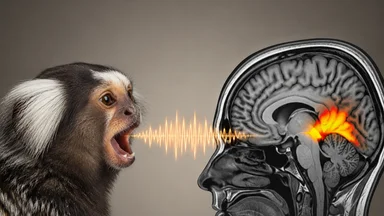
The main human fMRI study included 28 participants (N = 28) in a within-subject design. Whole-brain analysis revealed bilateral activation in the mid-superior temporal gyrus (mSTG) for the phee call compared to scrambled sound. The effect size was moderate to large (Cohen's d ≈ 1.0), similar to the marmoset results. The activated region overlapped with what is often called the "voice area" in humans—a region that responds more strongly to human vocalizations than to other sounds.
Scrambled calls produced a weaker, more distributed response across the auditory cortex, with lower peak activation. The human vowel sound activated a broader network including the superior temporal sulcus and inferior frontal gyrus, consistent with speech processing. The pure tone activated only primary auditory cortex (Heschl's gyrus).
The key finding was that the marmoset call—despite being unfamiliar and non-linguistic—elicited a response in the same cortical region that responds to human voices. This suggests that the mSTG is not exclusively tuned to human vocalizations but may be sensitive to acoustic features that are common across primate calls, such as harmonic periodicity and frequency modulation.
However, the effect was not as strong as for human vocalizations. In a direct contrast, the human vowel produced larger activation volumes and higher percent signal change than the marmoset call. The authors interpreted this as evidence for both shared and species-specific tuning.
How This Protocol Differs From Standard Speech Stimuli
Standard speech fMRI studies typically use words, sentences, or pseudowords. These stimuli activate a distributed language network that includes the superior temporal sulcus, middle temporal gyrus, and inferior frontal gyrus. The activations reflect lexical access, syntactic parsing, and semantic integration—processes that are absent when listening to a marmoset call.
By using a non-human primate call, the protocol isolates the acoustic-perceptual component of speech processing. It avoids confounds related to language proficiency, reading ability, or semantic priming. This is especially useful for studying auditory cortex in populations where language processing is atypical, such as infants or individuals with aphasia.
Another difference is the control condition. In speech studies, controls often include reversed speech or noise-vocoded speech. These preserve some acoustic features but introduce artifacts. The scrambled marmoset call, created by phase randomization, maintains the same frequency spectrum but destroys temporal structure—a cleaner control for temporal envelope processing.
The protocol also allows direct comparison with animal studies using the same stimulus. This is rare in human neuroimaging. Most human studies use stimuli that have no animal analogue, making cross-species inference indirect. The marmoset call provides a common currency.
One limitation is that the call is not species-typical for humans. The response may reflect general auditory novelty rather than a conserved vocalization-detection mechanism. The authors addressed this by including a familiar control (human vowel) and showing that the marmoset call response was distinct from the novelty response to scrambled sounds.
Implications for Cross-Species Comparative Neuroscience
The success of this protocol supports the idea that some auditory processing mechanisms are conserved across primates. The marmoset and human lineages diverged roughly 35 million years ago, yet both species show preferential responses to conspecific calls in homologous cortical regions. This challenges strong claims that human voice areas are unique evolutionary adaptations.
It also opens the door to using other primate calls as probes. For example, trill calls have different acoustic structure—rapid frequency modulation—and might probe different subregions of auditory cortex. Some groups have already begun adapting chimpanzee and macaque calls for human studies, though results are preliminary.
However, careful spectrotemporal matching is essential. A call that is meaningful for one species may be acoustically similar to environmental sounds for another. Researchers must verify that the adapted stimulus retains the features that drive selectivity in the original species. This requires close collaboration between ethologists and neuroimagers.
Another implication is for the interpretation of "voice selectivity" in human fMRI. If a marmoset call activates the voice area, then the region may be more accurately described as a "primate vocalization area" or "harmonic sound area." This does not diminish its importance for speech, but it reframes the evolutionary narrative.
Some researchers remain sceptical. They argue that the marmoset call response may be driven by low-level acoustic features—such as harmonicity—rather than vocalization-specific processing. The control conditions address this partially, but future studies could use calls from more distantly related species (e.g., birds) to test specificity.
Trade-Offs and Methodological Considerations
Adopting a cross-species stimulus involves several trade-offs. On the one hand, the marmoset call offers a naturalistic, ethologically valid sound that is free of linguistic confounds. On the other hand, its acoustic structure differs substantially from human speech, making direct comparisons tricky. For instance, the phee call's fundamental frequency (~3 kHz after shifting) is higher than typical human vowels (around 100–300 Hz for adult males). This mismatch could drive differences in cochlear place coding, potentially confounding species comparisons.
One way to address this is to include multiple frequency-matched controls. In the Tübingen study, the pure-tone control matched the shifted fundamental, but the harmonic richness of the call was not fully controlled. Future designs could use synthetic harmonic complexes with the same fundamental and harmonic spacing as the phee call but without the natural temporal envelope. This would help dissociate the contributions of harmonic structure versus natural amplitude modulations.
Another trade-off concerns the choice of scramble method. Phase randomization destroys temporal fine structure while preserving the long-term power spectrum. However, it also introduces random fluctuations that may sound unnatural. An alternative is to use a vocoded version that preserves temporal envelope but removes fine structure. Each method has different effects on neural responses, and the optimal choice depends on the research question.
Sample size is another consideration. The human study (N = 28) is typical for fMRI but may be underpowered for detecting small differences between conditions. A power analysis based on the marmoset effect size (d ≈ 1.2) suggests that about 20 participants would be needed to achieve 80% power at α = 0.05. The human study's d ≈ 1.0 is slightly lower, so the actual power may be around 70%. Replication in larger samples would strengthen confidence.
Finally, the protocol requires careful attention to stimulus duration. Marmoset phee calls last roughly 1–2 seconds, but the human study used 6-second blocks with multiple repetitions. This block design increases statistical power but may introduce adaptation effects. Event-related designs with jittered inter-stimulus intervals could provide more precise temporal information, albeit at the cost of longer scan times.
Practical Takeaways for Future fMRI Study Design
For researchers considering adopting this protocol, several practical lessons have emerged. First, pre-register the stimulus transformation pipeline. Small decisions about spectral shifting, resampling, and duration can affect results. Publicly sharing the code and audio files allows replication and cross-study comparison.
Second, report effect sizes. The original marmoset study reported d ≈ 1.2; the human study reported d ≈ 1.0. These values allow meta-analytic comparisons across species and labs. Many fMRI studies still report only p-values or z-scores, which are less informative for effect magnitude.
Third, consider call type. Phee calls are long, tonal, and relatively simple. Trill calls are short, rapidly modulated, and may engage different neural populations. A recent preprint from the University of Zurich compared phee and trill calls in human fMRI and found that trill calls produced stronger responses in the right auditory cortex, while phee calls were more bilateral. This hints at hemispheric specialization for temporal vs. spectral processing.
Fourth, use the protocol as a naturalistic control. In studies of speech perception, the marmoset call can serve as a non-linguistic vocalization baseline. It is more natural than tones or noise but lacks linguistic content. This can help disentangle auditory from language-specific effects.
Finally, the protocol is not a replacement for human speech stimuli. It is a complementary tool. The marmoset call reveals what the human brain shares with other primates; speech stimuli reveal what is unique. Both are needed for a complete picture.
Future Directions and Open Questions
Several open questions remain. First, how does the marmoset call response change with development? Infants and children may process the call differently due to immature auditory cortex or lack of experience with primate vocalizations. A developmental study could test whether the response is present from birth or emerges with exposure to natural sounds.
Second, can the protocol be extended to other modalities? For example, visual stimuli such as marmoset facial expressions could be adapted for human fMRI to study cross-species emotion processing. This would require similar spectrotemporal or spatial transformations to ensure comparability.
Third, what is the role of attention? In the human study, participants performed a passive listening task. Active tasks (e.g., detecting a target sound) might modulate the response in top-down attention networks. Comparing passive and active conditions could reveal how attentional state influences cross-species processing.
Fourth, how do individual differences in musical training or hearing acuity affect the response? Musicians might show enhanced sensitivity to harmonic structure, while individuals with hearing loss might show reduced responses. These factors could be explored in larger samples with audiometric screening.
Finally, the protocol could be combined with computational modeling. For instance, a spectrotemporal receptive field (STRF) model could be fitted to the fMRI data to characterize the tuning properties of voice-sensitive regions. Comparing STRF models across species would provide a formal test of conservation.
The migration of a marmoset vocalization protocol from primate ethology into human fMRI is a case study in cross-disciplinary method transfer. It required acoustic engineering, careful experimental design, and willingness to test a stimulus that sounds odd to human ears. The payoff is a deeper understanding of how our auditory cortex processes the sounds that matter most—whether from our own species or from a distant primate cousin.
As one of the study authors put it in a conference talk: "We spent years figuring out how to make a marmoset call sound like something a human would pay attention to. Turns out, the brain was already paying attention."